Last updated 2026-07-24
TL;DR
Yes, generally. Semax is a peptide, and peptides degrade faster at room temperature. Unopened vials or sprays are best kept refrigerated (roughly 2-8°C), while a bottle in active use is usually fine at room temperature for a limited number of weeks. There's no FDA-approved product with an official label to point to, so exact numbers vary by supplier.
does semax need to be refrigerated?
Short answer: yes, unopened Semax should be refrigerated, and most compounding pharmacies and suppliers recommend keeping it cold even after you've opened it, unless their specific label says otherwise. Semax is a synthetic peptide, a short heptapeptide built on the ACTH(4-10) fragment with a Pro-Gly-Pro tail added for stability . Peptides in general are floppy molecules held together by bonds that heat, light, and time can break down. Refrigeration slows that clock. It doesn't stop it. Here's the honest caveat before anything else: there is no FDA-approved Semax product in the United States, so there's no official FDA label with a validated stability study behind it. What exists in the US market comes through compounding pharmacies operating under 21 U.S.C. 353a , using bulk peptide material. Semax is not on the FDA's 503A bulk drug substances list as an approved bulk for compounding, and it doesn't appear on the 503B Bulks List either . That matters for storage guidance because it means there's no single authoritative stability dataset everyone is working from. Every supplier's "keep refrigerated" instruction is based on general peptide chemistry and their own manufacturer's data, not a harmonized FDA-reviewed shelf life. So the practical answer is: treat it like a peptide that wants to stay cold, follow whatever the pharmacy that fulfilled your specific bottle tells you, and don't assume all suppliers give you the same number of weeks at room temperature. For the deeper mechanics behind exact shelf-life windows, see our full guide to Semax storage and shelf life.
how should unopened semax be stored?
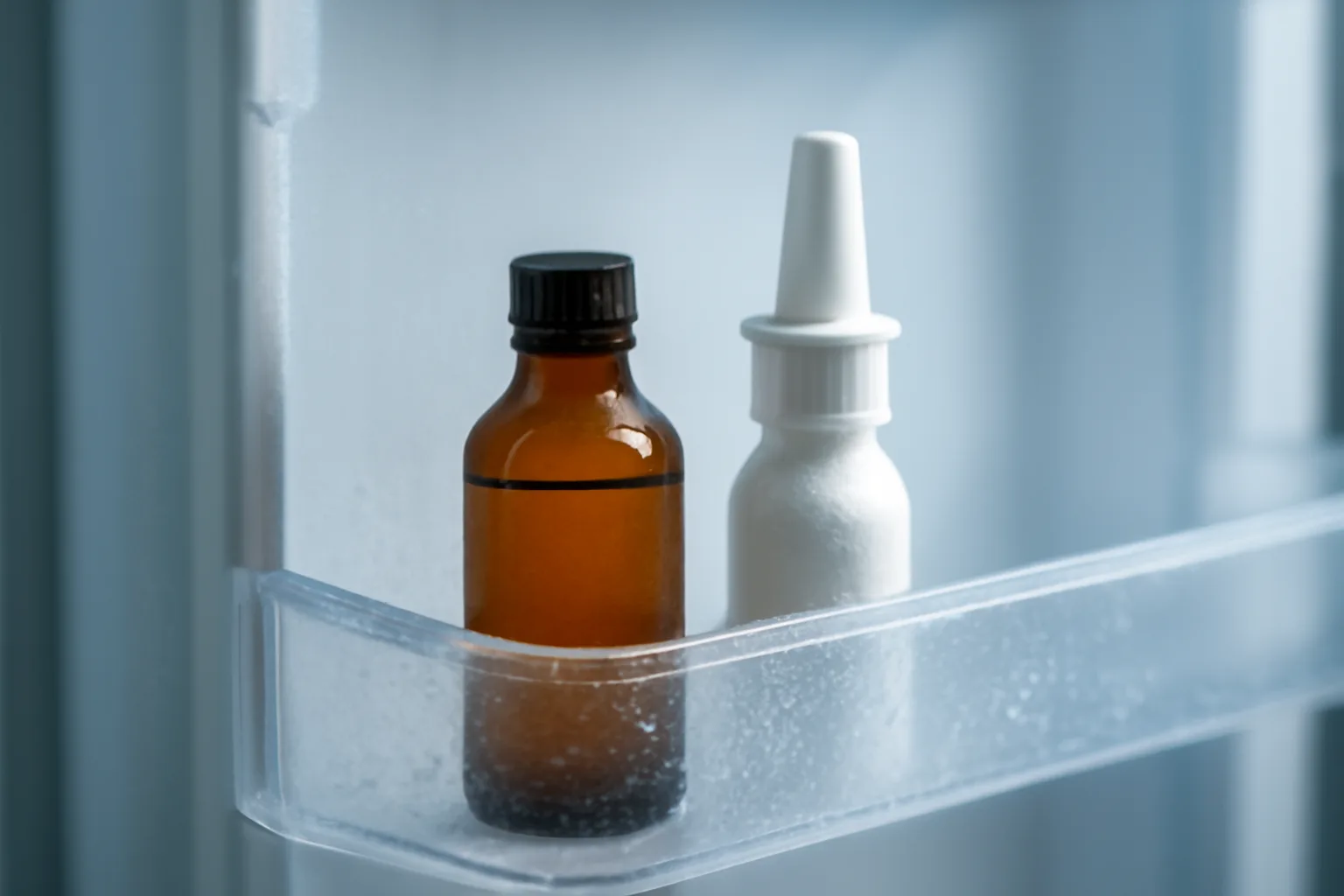
Unopened Semax, whether it's a lyophilized (freeze-dried) vial or a pre-mixed nasal spray, should sit in a refrigerator, generally cited in the 2-8°C (36-46°F) range that's standard for peptide products. Don't freeze it unless your specific product instructions say to. Freezing lyophilized peptide powder is sometimes fine and sometimes not, depending on the formulation and any stabilizers used, so this is one place where you really do want to defer to the paperwork that came with your specific order rather than a general rule. Keep it away from direct light. Peptides, like a lot of biologic molecules, can degrade faster with UV exposure, which is part of why most vials ship in amber or opaque packaging. If you bought lyophilized powder that needs reconstitution (mixing with bacteriostatic water or saline), the unreconstituted powder is generally more stable than the mixed solution and can often tolerate longer storage. Once mixed, the clock changes. More on that below, and in the fuller breakdown at our article on Semax storage and shelf life.
does semax nasal spray need refrigeration once it's opened?
Once you've cracked open a Semax nasal spray or reconstituted a lyophilized vial, most guidance says keep it refrigerated between uses, and use it within a defined window, commonly somewhere around 2 to 4 weeks, though this varies by supplier and by whether the product is pre-mixed or reconstituted by you. This is the point where storage advice genuinely splits between products. A pharmacy-fulfilled, provider-reviewed spray may carry a specific in-use stability window based on the compounder's own testing. A raw peptide vial you reconstitute yourself is a different animal: you introduced the water, you introduced the handling, and any stability data that came with the lyophilized powder doesn't necessarily transfer once it's liquid. A few practical habits matter regardless of source: - Keep the spray upright and capped when not in use.
- Return it to the fridge promptly rather than leaving it on a counter or in a bag.
- Avoid repeated big temperature swings (fridge to warm car to fridge) more than you avoid a single brief trip at room temperature.
- Don't share a bottle across long shipping delays without checking whether it was kept cold in transit. For the fuller breakdown of shelf life windows, reconstitution stability, and what "room temperature" tolerance really means for a few hours versus a few days, see our guide to Semax storage and shelf life.
what happens if semax isn't refrigerated?
The worst case isn't that it becomes dangerous. It's that it becomes less effective, or stops doing anything at all, without an obvious visual sign. Peptides degrade through mechanisms like oxidation, deamidation, and hydrolysis, all of which speed up with heat. Unlike a food safety failure, you generally won't see mold or smell spoilage. You'll just be spraying a solution with less intact active peptide in it than the label assumes, and you won't know how much less. This is a real gap in what anyone can tell you with confidence, because Semax doesn't have the kind of large-scale, FDA-reviewed stability program that, say, an approved biologic drug has. Nobody has published a definitive degradation curve for "Semax left in a hot car for six hours" versus "Semax left in a warm room for three days." The responsible thing to do is assume heat exposure reduces potency, and if a bottle has clearly been left somewhere hot (a mailbox in summer, a car dashboard) for an extended period, treat it as compromised rather than gambling on it. A brief exposure, like a few hours during a normal shipping day, is a different risk profile than days of exposure. Most suppliers build some tolerance for ordinary transit into their handling, which is part of why cold-chain shipping (insulated packaging, ice packs) is standard for these products.
how long can semax sit out at room temperature?
There's no single validated number that applies to every Semax product, but the general peptide-industry pattern is that brief room-temperature exposure, hours rather than days, is usually tolerated without meaningful loss, while sustained days-long exposure at room temperature is where real degradation risk climbs. Think of it less as a hard deadline and more as a cumulative heat budget. A bottle that spends two hours out of the fridge during normal use, several times over a few weeks, is a very different scenario than a bottle that gets left on a windowsill for a weekend. If your specific product's paperwork gives you a number (some compounding pharmacies do specify something like "stable at room temperature for up to X days"), that number should override any general rule here, because it reflects testing on that specific formulation. Absent that, the conservative approach, and the one most cautious users and reviewers land on, is: minimize room-temperature time, refrigerate as your default, and don't treat a missed evening in the fridge as a crisis, but don't make it a habit either.
why is semax temperature-sensitive in the first place?
Semax is a heptapeptide, seven amino acids, derived from the ACTH(4-10) fragment of adrenocorticotropic hormone with a Pro-Gly-Pro sequence added to slow the enzymatic breakdown that would otherwise happen quickly in the body . That Pro-Gly-Pro addition specifically extends its half-life against enzymes like aminopeptidases, which is part of why Semax works at all as an intranasal peptide rather than being destroyed almost instantly. But resistance to enzymatic degradation in the body isn't the same as resistance to thermal degradation in a bottle. Peptide bonds and side chains can still oxidize, deamidate, or otherwise rearrange under heat and light regardless of how the molecule behaves against biological enzymes. There's also a chemistry detail worth knowing if you're comparing products: researchers have looked specifically at how N-terminus acetylation of Semax changes its coordination with copper(II) and zinc(II) ions and how that affects biological properties [1]. Metal-ion interactions and molecular stability are related territory, and it's one more reason why formulation details (more than "is it Semax") can affect how a given product holds up over time. This is chemistry, not a shelf-life guarantee, but it explains why two "Semax" products from two different sources aren't guaranteed to behave identically in storage.
does semax need to be refrigerated during shipping?
Ideally, yes, or at minimum shipped in a way that limits heat exposure, which is why legitimate suppliers typically use insulated packaging, sometimes with ice packs or cold packs, especially during warmer months or longer transit times. If a package sits in a hot delivery truck or on a porch for an extended period during summer, that's meaningful heat exposure before you've even opened the box. This is worth checking for, especially with any supplier that doesn't clearly describe their shipping and handling process. This is also one of the practical reasons to care about where a product comes from at all. A provider-reviewed source working with a real compounding pharmacy has an actual incentive and infrastructure to manage cold chain properly, because their name is on the fulfillment. A random online seller with no pharmacy relationship has much less accountability if your product arrives warm, degraded, or mislabeled. If you're comparing where to source from and what that costs, our breakdown of Semax cost and pricing covers how pricing structures differ between direct-to-consumer sellers and pharmacy-fulfilled, provider-reviewed routes.
is it safe to use semax that wasn't refrigerated properly?
This is a safety question and an efficacy question tangled together, and they don't have the same answer. On efficacy: a peptide that's degraded from heat exposure will likely just work less well, or not at all, rather than turning into something actively harmful. Degradation products from a short heptapeptide are generally not expected to be toxic in the way a completely different compound might be. On safety more broadly: Semax carries the general uncertainty that comes with any product operating outside FDA-approved-drug oversight. There's no Drugs@FDA listing for Semax , meaning there's no FDA-reviewed safety and efficacy dossier the way there is for an approved medication. Combine that with a temperature-abused bottle and you're stacking one uncertainty (nobody has FDA-grade data on Semax generally) on top of another (this specific bottle may have lost potency). Neither one on its own is likely to make you sick. Together, they're a good reason to just not use a bottle you know got seriously overheated, and to talk to whatever provider reviewed your use of it if you're unsure. For a broader look at what's known and not known about Semax safety over time, see our article on Semax long term side effects.
how do i know if my semax has gone bad?
Honestly, you often can't tell by looking. This is one of the more frustrating realities of peptide storage. Unlike, say, milk, a degraded peptide solution doesn't reliably turn cloudy, change color, or smell different in a way you can rely on. Visible cloudiness, discoloration, or particulate matter in a solution that used to be clear is a legitimate red flag and reason to discard it. But the absence of visible change is not proof the peptide is still fully potent. The closest thing to objective guidance is tracking two things: time since first use (or first reconstitution) and cumulative heat exposure. If a bottle is well past its stated in-use window, or you know it sat somewhere hot for an extended stretch, the prudent move is to treat it as degraded even if it looks normal, rather than assume it's fine because nothing looks wrong. This is also why buying from a source that gives you clear dating and storage instructions on the actual product matters more than it might seem. A bottle with no lot number, no fill date, and no stated in-use window gives you nothing to judge degradation against. The full walkthrough of dating, reconstitution windows, and what to check on a label lives at our guide to Semax storage and shelf life.
what does the research actually say about semax, and does that affect storage confidence?
Here's the thing nobody selling Semax wants to say plainly, so we will: the evidence base for Semax is real, it's decades deep, and it's almost entirely Russian. That matters for storage confidence too, because it means there's no Western, FDA-style stability and quality-control apparatus behind any given product. Semax has been used clinically in Russia for conditions including ischemic stroke, where a Russian-language study in Zhurnal nevrologii i psikhiatrii imeni S.S. Korsakova reported on its efficacy across different stages of stroke treatment . Mechanistic work, much of it out of Russian institutions, has looked at Semax's effects on brain-derived neurotrophic factor levels in rat basal forebrain , transcription of neurotrophins after cerebral ischemia [2], and gene expression changes tied to immune and vascular pathways in ischemic brain tissue [10, 22, 26]. More recent work has extended into new territory: a 2025 study in the British Journal of Pharmacology found Semax targets the μ opioid receptor gene Oprm1 to promote deubiquitination and functional recovery after spinal cord injury in female mice [3], and a 2026 review in the Journal of the American Academy of Orthopaedic Surgeons' global research and reviews journal discusses therapeutic peptides, including work relevant to orthopaedic applications [4]. This is a genuinely interesting and reasonably large body of work. It is not the same thing as a Western multi-site randomized controlled trial pipeline, and it is not the same thing as FDA approval. Russian regulatory use of Semax as an approved medicine there doesn't transfer to FDA status in the US, any more than a drug approved in the US automatically has approval elsewhere. None of this tells you much directly about shelf life or refrigeration, honestly, since stability testing is a separate discipline from efficacy research. But it's the context you need before trusting any supplier's storage claims: without a harmonized regulatory dossier, storage guidance is only as good as the individual compounder's own testing and honesty. If you want the fuller picture on what the research does and doesn't establish about long-term use, see our article on Semax long term side effects.
should you trust a supplier that says semax doesn't need refrigeration?
Be skeptical. Given everything above, a supplier claiming their Semax is shelf-stable at room temperature indefinitely is making a claim that isn't backed by a public, harmonized stability dataset, and it should prompt questions rather than reassurance. That doesn't automatically mean they're lying. Some formulations, buffers, or lyophilization approaches genuinely are more heat-tolerant than others, and a compounding pharmacy with its own internal testing could have real data supporting a longer room-temperature window for their specific product. The difference is whether they can point to their own stability testing versus whether they're just saying what's convenient to ship cheaply. A reasonable bar: ask what temperature range the product was tested at, for how long, and whether that data is specific to their formulation or a general industry assumption. If you get a vague answer, default to refrigeration regardless of what the label says. It costs you nothing to keep it cold, and it protects you from the one scenario, quiet potency loss, that you'd otherwise never notice. If price is part of why you're weighing one supplier against another, our guide to Semax cost and pricing walks through what you're actually paying for at each price point.
the bottom line on semax and refrigeration
Refrigerate it. Unopened, opened, mixed, or pre-filled, the safe default for Semax is 2-8°C storage, minimal room-temperature time, and disposal of anything that's had extended heat exposure or is clearly past its in-use window. There's no FDA-approved product and no single official label to lean on here, so exact numbers (how many weeks once opened, how many hours tolerable at room temperature) genuinely differ by supplier and formulation. That's not a reason to panic. It's a reason to buy from a provider-reviewed source that gives you clear storage instructions specific to your bottle, rather than guessing based on generic peptide advice or a forum post. If you want the deeper mechanics, exact shelf-life windows by product type, and what "stability" actually means for reconstituted peptide, the fuller treatment is at our guide to Semax storage and shelf life.
Frequently asked questions
does semax need to be refrigerated after opening?
Generally yes. Most guidance recommends keeping opened Semax nasal spray or reconstituted vials refrigerated between uses, with a limited in-use window, often cited around 2 to 4 weeks, though this varies by supplier and formulation. Check your specific product's instructions, since there's no single FDA-approved label everyone follows.
can semax be left at room temperature overnight?
A single overnight lapse is unlikely to ruin a bottle, since brief room-temperature exposure is generally more tolerable than sustained heat exposure. But it's not something to make a habit of. If it happens once, return it to the fridge and continue normal use; if it happens repeatedly or for days at a time, treat the product as potentially degraded.
how long does semax last unrefrigerated?
There's no universally validated number. Brief exposure (hours) during normal handling or shipping is usually tolerated; sustained exposure over days at room temperature raises real degradation risk. Peptides in general aren't shelf-stable at room temperature the way small-molecule drugs often are, so minimizing time outside the fridge is the safest default.
does semax lose potency if not kept cold?
Likely yes, gradually. Heat speeds up peptide degradation processes like oxidation and deamidation, and there's no visible sign when this happens. You won't see discoloration or smell spoilage in most cases; you'd just get less active peptide per dose than the label assumes, without knowing it.
is semax nasal spray safe to use if it wasn't shipped cold?
Using degraded Semax is more likely to mean reduced effectiveness than acute harm, since peptide breakdown products from a short heptapeptide aren't generally expected to be toxic. Still, since Semax has no FDA-approved safety dossier, a bottle with uncertain shipping conditions adds one more layer of uncertainty worth avoiding rather than gambling on.
can you freeze semax?
Only if your specific product's instructions say to. Freezing lyophilized peptide powder is sometimes acceptable and sometimes not, depending on the formulation and stabilizers used. Freezing a reconstituted, mixed solution is generally riskier and can affect the delivery device if it's a spray. Defer to your supplier's specific guidance rather than a blanket rule.
does semax have FDA approval, and does that affect storage guidance?
No. There is no FDA-approved Semax product listed in Drugs@FDA, the FDA's database of approved drugs. It's available in the US only through compounding under 21 U.S.C. 353a. That means storage guidance comes from individual compounders' own data, not a single FDA-reviewed stability study, which is why numbers vary by supplier.
why is semax not on the FDA's approved bulk drug substances list?
Semax is not on the FDA's current 503A Bulks List (21 CFR 216.23) or the 503B Bulks List (21 CFR 216.24), the lists of bulk substances FDA has reviewed for use in compounding. This affects regulatory clarity around the substance generally, including the absence of standardized, agency-reviewed stability data.
is the research on semax as strong as an FDA-approved drug's data?
No, and it's worth being direct about that. Semax has a genuinely substantial body of research behind it, much of it Russian clinical and mechanistic work spanning decades, but it hasn't gone through the Western randomized controlled trial pipeline that FDA approval requires. It's real evidence, just not evidence at that regulatory bar.
should i trust a seller who says their semax doesn't need refrigeration?
Be cautious. Ask what stability testing backs that claim and at what temperature and duration. Without a public dataset, a room-temperature-stable claim is unverified. The safer default, regardless of what a label says, is to refrigerate anyway; it costs nothing and protects against quiet potency loss you wouldn't otherwise notice.
does the color or clarity of semax solution tell you if it's degraded?
Partly. Visible cloudiness, discoloration, or particles in a solution that was originally clear is a real red flag and reason to discard it. But the reverse isn't true: a normal-looking solution isn't proof it's still fully potent, since most peptide degradation isn't visible to the eye.
does shipping temperature matter when buying semax online?
Yes. Reputable suppliers typically ship in insulated packaging, sometimes with cold packs, to limit heat exposure in transit. A package left in a hot truck or on a porch for hours during summer heat is meaningful thermal stress before you've even opened it, which is one reason sourcing from an accountable, provider-reviewed pharmacy relationship matters.
Sources
- Journal of the American Academy of Orthopaedic Surgeons. Global research & reviews (PMID 41490200): 2026 review discusses therapeutic peptides in orthopaedic applications, challenges, and future directions
- British Journal of Pharmacology (PMID 40692165): Semax targets the μ opioid receptor gene Oprm1 to promote deubiquitination and functional recovery after spinal cord injury in female mice
- Journal of Inorganic Biochemistry (PMID 27586814): N-terminus acetylation of Semax affects its coordination with copper(II) and zinc(II) ions and related biological properties
- BMC Genomics (PMID 24661604): Semax affects expression of genes related to immune and vascular systems in rat brain focal ischemia
- Cellular and Molecular Neurobiology (PMID 19633950): Semax and Pro-Gly-Pro activate transcription of neurotrophins and their receptor genes after cerebral ischemia
- Zhurnal nevrologii i psikhiatrii imeni S.S. Korsakova (PMID 29798983): Russian-language clinical study reports on efficacy of Semax in treatment of patients at different stages of ischemic stroke
- Neurochemical Research (PMID 16362768): Semax is an ACTH(4-10) analogue with nootropic properties that activates dopaminergic and serotoninergic brain systems in rodents
- Cornell Law School Legal Information Institute, 21 U.S.C. 353a: Pharmacy compounding of drugs including peptides like Semax in the US occurs under the statutory framework of 21 U.S.C. 353a
- eCFR, 21 CFR 216.23, the 503A Bulks List: Semax is not listed among the bulk drug substances approved on the FDA's 503A Bulks List for compounding
- eCFR, 21 CFR 216.24, the 503B Bulks List: Semax is not listed among the bulk drug substances approved on the FDA's 503B Bulks List for outsourcing facility compounding
- Drugs@FDA, FDA-approved drug products database: There is no FDA-approved Semax drug product listed in the Drugs@FDA database
- Journal of Neurochemistry (PMID 16635254): Semax binds specifically and increases levels of brain-derived neurotrophic factor protein in rat basal forebrain
- Molecular Genetics and Genomics (PMID 28255762): Semax regulates expression of immune response genes during ischemic brain injury in rats
- Genes (PMID 32580520): ACTH(4-7)PGP peptide (Semax) shows protective transcriptomic effects following cerebral ischaemia-reperfusion in rats