Last updated 2026-07-25
TL;DR
Unopened Semax stays stable frozen or refrigerated for months, but once a vial is reconstituted or opened, refrigerate it at 2-8°C and expect a usable window of a few weeks, not months. There's no FDA-set shelf life because Semax isn't an FDA-approved drug. Compounded batches carry pharmacy-assigned beyond-use dates that are more conservative than manufacturer claims from Russia.
How should you store Semax nasal spray?
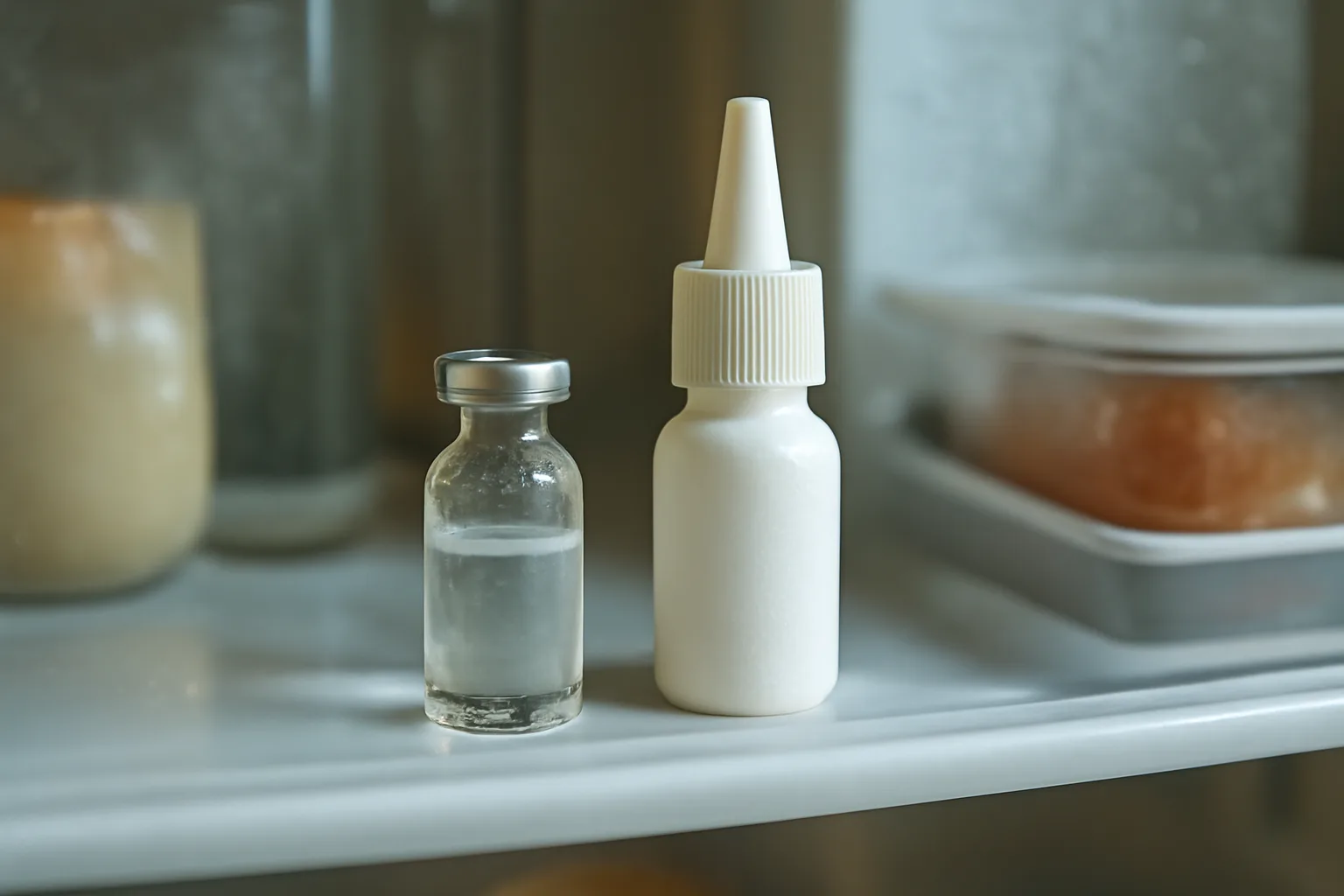
Keep unopened Semax in the refrigerator, ideally between 2°C and 8°C (36°F to 46°F). Some Russian manufacturer labeling allows freezer storage for unopened stock, but once a bottle or vial is in use, refrigeration (not freezing) is the standard advice from compounding pharmacies handling similar peptide nasal sprays. Don't leave it on a counter or in a car. Peptides like Semax are short chains of amino acids, and heat plus time is exactly what breaks peptide bonds down. There's no published Semax-specific accelerated-stability paper in the PubMed record reviewed here that gives a precise degradation curve at room temperature, so anyone quoting an exact percentage loss per day at 25°C is guessing. The honest answer is: nobody has published that specific number for Semax, and the conservative move is to treat it like other compounded peptides and keep it cold except for the seconds it takes to dose. If you're working with a reconstituted vial rather than a pre-made spray, the mixing method itself matters for stability too. See how to reconstitute semax for the actual steps, since improper dilution or using the wrong diluent can shorten usable life independent of temperature.
What is the actual shelf life of Semax once opened?
Once opened or reconstituted, most compounding pharmacies and peptide-handling guidance treat a working supply of Semax as good for roughly 2 to 4 weeks under refrigeration, sometimes stretched to 30 days if kept consistently cold and protected from light. This is a practical window, not a number pulled from a Semax-specific stability trial published in a Western journal, because that trial doesn't exist in the literature this article draws from. Unopened, sealed product (whether frozen or refrigerated by the original manufacturer) can carry a longer claimed shelf life, sometimes cited as 1 to 2 years on Russian retail packaging. But that figure comes from manufacturer labeling in Russia, not an FDA-reviewed stability study, and the U.S. has no Drugs@FDA entry for Semax at all [1]. If you search the FDA's approved drug database for Semax, you'll find nothing, because it has never gone through FDA review. The practical rule: once air, light, and repeated temperature swings from fridge to counter start hitting the solution, the clock is running faster than the label implies. Treat 3 to 4 weeks after opening as the outer edge, and if the spray looks cloudy, discolored, or smells different than when you got it, don't use it.
Does Semax need to be refrigerated, or can it sit at room temperature?
It needs refrigeration for any meaningful storage period. A dose in your hand for the few minutes it takes to administer isn't a problem. Leaving a vial in a gym bag for an afternoon, or on a bathroom shelf that gets warm and humid, is a real risk to potency. Peptide nasal sprays in general are compounded and dispensed with cold-chain handling in mind, similar to how injectable peptides are shipped with ice packs. This isn't unique to Semax, it's true of most small peptide actives regulated under the FDA's bulk drug substance framework for compounding, where 21 CFR 216.23 and 216.24 govern which substances pharmacies can use for 503A and 503B compounding respectively [2][3]. Nothing in that framework sets a universal shelf life for a given peptide; that's left to the compounding pharmacy's own stability assessment and beyond-use dating. If you're unsure whether a specific batch was kept cold in transit, ask the pharmacy that filled it what their beyond-use date policy is. A provider-reviewed source should be able to tell you exactly how they arrived at that date, rather than pointing you to a foreign product insert.
Can Semax be frozen, and does freezing extend shelf life?
Unopened, unreconstituted Semax can typically tolerate freezing, and some manufacturer guidance from Russia recommends freezer storage for long-term unopened stock. Once you've reconstituted a peptide or opened a spray bottle, freezing is generally not recommended, because repeated freeze-thaw cycles can physically stress the peptide and any excipients in solution, and a nasal spray pump mechanism isn't built to be frozen and thawed repeatedly anyway. If you have unopened backup vials and want to store them for months, freezing is a reasonable way to preserve the unopened product, similar to how many biologic and peptide products are shipped and stored frozen prior to first use. Once you pull a vial to start using it, move it to the refrigerator and don't put it back in the freezer. There isn't a peer-reviewed freeze-thaw stability study specific to Semax in the literature covered here, so this guidance is drawn from general peptide handling practice rather than a Semax-specific citation. Be skeptical of anyone stating a precise number of freeze-thaw cycles Semax can withstand; that specific figure hasn't been published.
How do you know if Semax has gone bad?
Watch for cloudiness, visible particles, a color change, or an off smell. Clear, colorless to faintly yellow solution is what you'd expect from an intact peptide nasal spray. If the spray pump starts clogging or spraying unevenly, that can also signal the solution has degraded or precipitated. Degraded peptide doesn't necessarily turn visibly ugly before it loses potency, though. Peptide bonds can hydrolyze or peptides can deamidate/oxidize without an obvious visual cue, so the absence of visible spoilage doesn't guarantee full potency past the recommended window. This is exactly why the beyond-use date and storage temperature matter more than a gut check on appearance. If you've stored a vial outside the recommended range (left in a hot car for a day, for example), the safest move is to discard it rather than test whether it still works. The downside of tossing a partly-used vial is a wasted purchase; the downside of using a degraded one is an ineffective or unpredictable dose.
Why doesn't the FDA set an official shelf life for Semax?
Because Semax has never been reviewed or approved by the FDA as a drug product in the United States. A search of Drugs@FDA, the agency's official database of approved drug products, returns no Semax entry [1]. Shelf life determinations (expiration dating) are part of the FDA New Drug Application process; without an approved application, there's no FDA-reviewed stability data package and no FDA-assigned expiration date. In the U.S., Semax is available only through compounding, under the framework set by 21 U.S.C. 353a for pharmacy compounding [4] and the FDA's bulk drug substance lists for 503A and 503B facilities [5][6]. Compounding pharmacies assign their own beyond-use dates based on general USP compounding standards and their own stability testing or literature review, not an FDA-approved package insert. That's why you'll see different beyond-use dates from different pharmacies for what looks like the same product. This matters for shelf life specifically: any expiration or beyond-use date you're given for a compounded Semax product is a pharmacy-level judgment call, generally conservative, and worth asking about directly rather than assuming it matches whatever a Russian manufacturer's box says.
Is Russian manufacturer shelf-life labeling reliable for U.S. buyers?
Semax has a long clinical history in Russia, where it's registered and has been used for decades in stroke recovery, cognitive complaints, and related conditions [7]. That history is real and the underlying pharmacology literature is fairly extensive, covering everything from BDNF upregulation [8] to gene expression changes after ischemia [9][10]. But Russian drug registration is not the same regulatory bar as FDA approval, and it doesn't come with the same publicly auditable stability-testing package that a Western reader can independently check. This is worth being blunt about: the Semax evidence base is overwhelmingly Russian-language, built on Russian regulatory approval and decades of domestic clinical use, and it has not been replicated in Western randomized controlled trials. That doesn't make the pharmacology fake, several serious mechanistic studies (on BDNF [8], dopaminergic and serotonergic activation [11], neuroinflammatory gene expression [12][13]) hold up as real science. But it does mean a shelf-life or stability claim printed on Russian retail packaging hasn't been vetted by the same process that, say, an FDA-approved nasal spray's expiration date has. Treat those numbers as a starting reference point, not gospel, and defer to whatever beyond-use date your actual compounding pharmacy assigns.
Does storage temperature affect how well Semax works?
Yes, in principle, though there's no Semax-specific dose-response-after-heat-exposure study to point to. What we do know from the broader peptide literature is that Semax's activity depends on an intact peptide structure interacting with specific biological targets, for instance recent work shows Semax acting on the μ-opioid receptor gene Oprm1 to promote functional recovery after spinal cord injury in mice [14], and other studies show it binding specifically to modulate BDNF levels in rat basal forebrain [8]. A peptide that's been broken down by heat or degraded in solution isn't the same molecule interacting with those targets anymore. So the logical chain is straightforward even without a temperature-specific Semax study: intact peptide structure matters for the documented mechanisms, heat and time degrade peptide structure, therefore poor storage plausibly reduces effect. That's an inference from mechanism studies, not a direct citation for "Semax loses X% potency at Y temperature," and readers should hold that distinction clearly. If you're trying to judge whether a batch might be underpotent from storage issues, look at practical proxies: how long has it been open, was it kept cold, does the spray mechanism and appearance look normal. None of those are as good as an assay, but assays aren't something a consumer can run at home.
How should Semax be stored while traveling?
Use an insulated bag with a small ice pack or gel pack for anything longer than a couple of hours outside the fridge. Airport security generally allows medications and medical liquids through checkpoints, but pack it in carry-on rather than checked luggage, since checked cargo holds can hit temperature extremes on the tarmac that are worse than anything in a car. For day trips, a small insulated pouch (the kind used for insulin) keeps a vial cool enough for a few hours without needing dry ice or anything elaborate. For multi-day travel, plan around access to a hotel mini-fridge or a cooler with ice you can refresh. Don't check it as luggage, don't leave it in a hot vehicle, and don't assume a few hours of room temperature during a single travel day ruins the whole vial. Occasional short excursions from the fridge are different from routine, dayslong room-temperature storage.
How does Semax's storage compare to other nootropic peptides?
| Peptide | Typical unopened storage | Typical opened/reconstituted storage | Regulatory status in U.S. |
|---|---|---|---|
| Semax | Refrigerated or frozen, per manufacturer labeling | ~2-4 weeks refrigerated | Not FDA-approved; compounded only [1][4] |
| Selank | Similar cold-chain handling; studied alongside Semax in connectomic imaging work [15] | ~2-4 weeks refrigerated (pharmacy-dependent) | Not FDA-approved; compounded only |
| Standard compounded peptide nasal sprays generally | Refrigerated 2-8°C per USP-based BUD assignment | Pharmacy-assigned beyond-use date, often weeks | Governed by 503A/503B bulk substance rules [2][3] |
The table above reflects general compounding-pharmacy practice for peptide nasal sprays, not a single head-to-head stability study comparing these products. Selank and Semax show up together in at least one functional connectomic imaging study examining their distinct effects on brain networks [15], which tells you about mechanism, not shelf life; don't conflate the two.
What's the bottom line on storing Semax correctly?
Refrigerate it, don't freeze it once opened, use it within a few weeks of opening, and don't trust a printed shelf-life number more than the actual compounding pharmacy's beyond-use date on your specific vial. If in doubt, ask the pharmacy directly what their stability data supports. Because Semax sits outside FDA approval, there's no substitute for getting your supply from a provider-reviewed source that can actually answer questions about how a batch was made, tested, and dated. Semax Labs works with a provider-reviewed pathway and names the fulfilling pharmacy partner precisely so buyers aren't left guessing at storage and potency questions from an anonymous seller. Semax Labs doesn't compound or manufacture the product itself, it connects readers to that reviewed pathway. For the practical mechanics of mixing a fresh vial correctly (which also affects how long it stays good), see how to reconstitute semax. And if storage and potency questions have you thinking about safety more broadly, is semax safe and semax long term side effects are worth reading before you start.
Frequently asked questions
How long does Semax last once opened?
Most compounding pharmacy guidance and general peptide-handling practice put the usable window at roughly 2 to 4 weeks after opening or reconstituting, provided it's kept refrigerated at 2-8°C. There's no published Semax-specific stability trial giving an exact number, so treat this as a practical range, not a precise figure, and check your specific pharmacy's beyond-use date.
Can Semax be left out of the fridge for a few hours?
A short window, a few hours during travel or dosing, is generally fine and won't ruin the product. Routine room-temperature storage over days or weeks is the real risk. If a vial sat in a hot car or direct sun for an extended period, it's safer to discard it than to assume it's still potent.
Does Semax need to be refrigerated?
Yes. Refrigeration at roughly 2-8°C (36-46°F) is the standard recommendation for both unopened backup stock and any vial currently in use. Peptides degrade faster with heat exposure, and there's no FDA-reviewed stability data for Semax to say otherwise, since it isn't an FDA-approved drug [1].
Can you freeze Semax to make it last longer?
Unopened vials can often be frozen per manufacturer guidance from Russia, and this is a reasonable way to store backup supply long-term. Once a vial is opened or reconstituted, avoid freezing, since freeze-thaw cycles stress the peptide and the nasal spray pump mechanism isn't designed for it.
How can you tell if Semax has expired or gone bad?
Look for cloudiness, particles, color change, an off smell, or a pump that sprays unevenly or clogs. That said, peptide degradation from oxidation or hydrolysis doesn't always show a visible sign, so appearance alone isn't a reliable potency test. When in doubt, especially after a storage lapse, discard it.
Why isn't there an official FDA expiration date for Semax?
Because Semax has never gone through FDA new drug approval; it doesn't appear in the Drugs@FDA database of approved products [1]. Expiration dating in the U.S. comes out of that approval process. In the U.S., Semax is available only through compounding under 21 U.S.C. 353a, and beyond-use dates are set by the compounding pharmacy, not the FDA [4].
Is the Russian shelf-life claim on Semax packaging trustworthy?
It reflects decades of domestic manufacturing and regulatory experience in Russia, but Russian drug registration isn't equivalent to FDA approval, and the stability data behind that label isn't independently published or reviewed the way an FDA-approved product's would be. Use it as a rough reference, and defer to your compounding pharmacy's beyond-use date for anything you actually purchase in the U.S.
Does storing Semax wrong reduce how well it works?
Logically, yes: Semax's documented mechanisms, like binding effects tied to BDNF regulation [8] and receptor-level activity such as Oprm1 modulation in spinal cord injury models [14], depend on an intact peptide. Heat and time degrade peptide structure. There's no direct Semax study measuring potency loss at specific temperatures, but the mechanistic logic supports treating storage seriously.
Can Semax be shipped without refrigeration?
Short shipping windows (a day or two, especially in cooler weather) are commonly handled without active cold packs by many compounding pharmacies, similar to other peptide nasal sprays. Longer transit times or hot climates generally call for insulated packaging with ice packs. Ask your specific pharmacy how they ship and what temperature range the product tolerates in transit.
What's the difference between beyond-use date and expiration date for Semax?
An expiration date comes from an FDA-approved drug's own stability testing package, which Semax doesn't have. A beyond-use date (BUD) is what compounding pharmacies assign instead, based on general USP compounding standards and their own judgment, and it's typically more conservative. Any Semax product in the U.S. will carry a BUD, not a true FDA expiration date.
Should Semax be stored away from light as well as heat?
Yes, keeping it in its original opaque or dark packaging and out of direct sunlight is a reasonable precaution, consistent with how most peptide solutions are handled. Light exposure combined with heat compounds degradation risk. There's no Semax-specific photostability study cited here, so this is standard peptide-handling caution rather than a documented finding.
Does an unopened Semax vial last longer than an opened one?
Yes, substantially. Unopened, properly stored (refrigerated or frozen per labeling) stock can carry a manufacturer-claimed shelf life of a year or more from Russian packaging, while an opened or reconstituted vial is generally treated as good for only a few weeks under refrigeration by compounding pharmacies.
Sources
- FDA, Drugs@FDA approved drug products database: Semax does not appear in the FDA's database of approved drug products, meaning it has no FDA-assigned expiration dating.
- 21 CFR 216.23, the final 503A Bulks List: Bulk drug substances used in 503A pharmacy compounding are governed by this federal list, not by manufacturer stability data alone.
- 21 CFR 216.24, the 503B Bulks List: Bulk drug substances used in 503B outsourcing facility compounding are governed by a separate federal list under this section.
- 21 U.S.C. 353a, pharmacy compounding statute: Semax is available in the U.S. only through pharmacy compounding under this statute, since it lacks FDA new drug approval.
- FDA, bulk drug substances used in compounding under section 503A: FDA maintains the framework and process for evaluating bulk drug substances nominated for use in 503A compounding.
- FDA, bulk drug substances nominated for use in compounding (current list): FDA publishes and updates the current list of bulk drug substances nominated for compounding use.
- Zhurnal nevrologii i psikhiatrii imeni S.S. Korsakova, 2018 (PMID 29798983): Semax has been studied and used clinically in Russia for patients at different stages of ischemic stroke.
- Journal of Neurochemistry, 2006 (PMID 16635254): Semax binds specifically and increases levels of brain-derived neurotrophic factor (BDNF) protein in rat basal forebrain.
- BMC Genomics, 2014 (PMID 24661604): Semax affects expression of genes related to the immune and vascular systems in rat brain focal ischemia, per genome-wide transcriptional analysis.
- Biomedicines, 2024 (PMID 39767736): ACTH-like peptides including Semax compensate rat brain gene expression profiles disrupted by ischemia a day after experimental stroke.
- Neurochemical Research, 2005 (PMID 16362768): Semax activates dopaminergic and serotoninergic brain systems in rodents, consistent with its described nootropic properties.
- Molecular Genetics and Genomics, 2017 (PMID 28255762): Semax regulates expression of immune response genes during ischemic brain injury in rats.
- Genes, 2020 (PMID 32580520): The Semax-related peptide ACTH(4-7)PGP shows protective transcriptome-level effects following cerebral ischemia-reperfusion in rats.
- British Journal of Pharmacology, 2025 (PMID 40692165): Semax targets the μ opioid receptor gene Oprm1 to promote deubiquitination and functional recovery after spinal cord injury in female mice.
- Doklady Biological Sciences, 2020 (PMID 32342318): A functional connectomic imaging study examined and distinguished the effects of Selank and Semax on brain networks.